What is a Quad Core Processor, Working, Power Consumption & Performance
Published: 17 Sep 2026
A Quad core processor means a CPU that contains four separate processing cores inside a single processor chip. Each core can handle instructions and perform computing tasks, allowing the cpu to work on multiple tasks more efficiently than a single-core or dual-core processor.
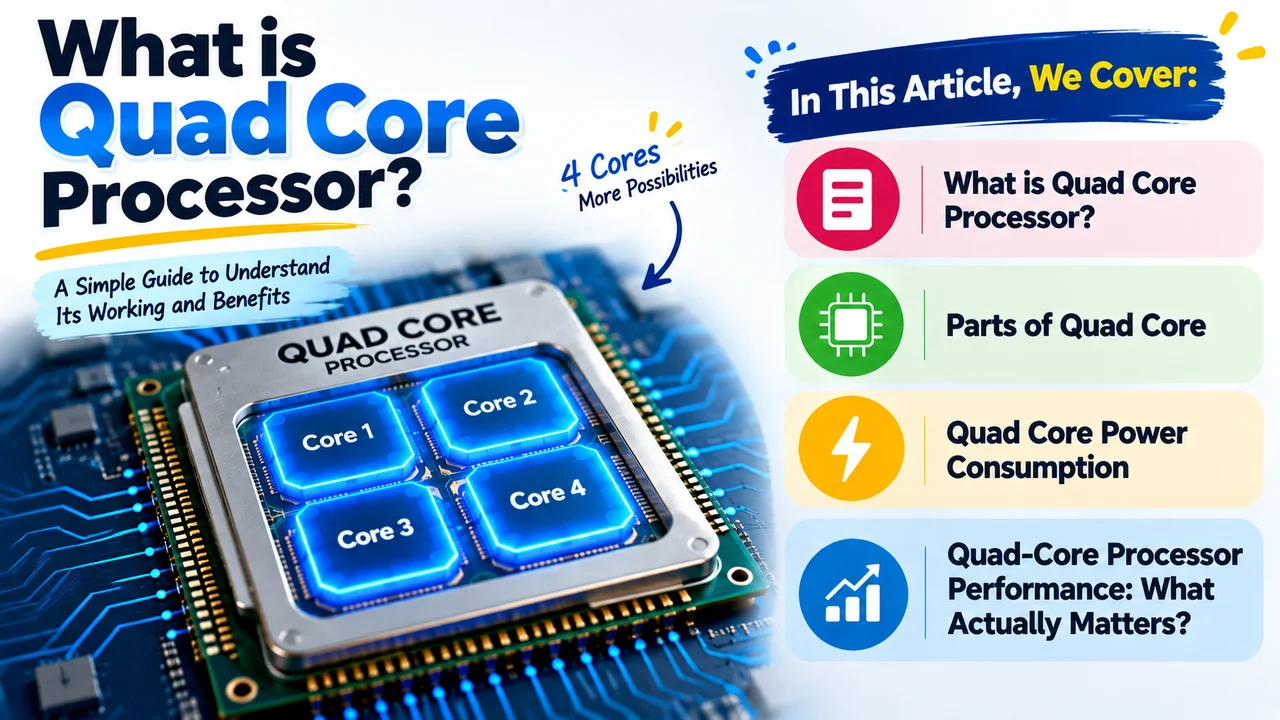
When you open several programs at once, such as a web browser, video player, and document editor, the operating system can distribute different tasks across the available cores.
This four core processor helps the computer handle multitasking more smoothly. However, having four cores does not automatically make every quad-core processor equally fast. Its actual performance also depends on factors such as clock speed, CPU generation, architecture, cache, and software support.
In simple words, a quad-core processor gives a computer four processing units that can work together to handle everyday tasks and applications more efficiently.
Parts Each Core Has:
Each core works as an individual processing unit and includes its own:
- cache Memory – Stores frequently used data for quick access.
- Control Unit – Directs and manages instructions.
- alu – Performs calculations and logical operations.
- registers – Hold small amounts of data temporarily.
- Clock – Controls the timing of processing operations.
Do Quad-Core Processors Use More Power?
A quad-core processor can use more power than a single-core or dual-core processor, but the number of cores alone does not determine power consumption.
A CPU’s power use also depends on its architecture, clock speed, manufacturing process, workload, and power settings. When all four cores are working on demanding tasks, the processor usually consumes more power and produces more heat.
However, modern quad-core CPUs can reduce their power use when the computer is performing light tasks by lowering their clock speed or putting unused cores into low-power states. So, a well-designed modern quad-core processor can be both powerful and energy-efficient.
Quad-Core Processor Performance: What Actually Matters?
A quad-core processor is not judged by its four cores alone. A modern quad-core CPU can be much faster than an older quad-core processor because newer CPUs often have better architecture, higher performance per core, improved efficiency, and faster memory support.
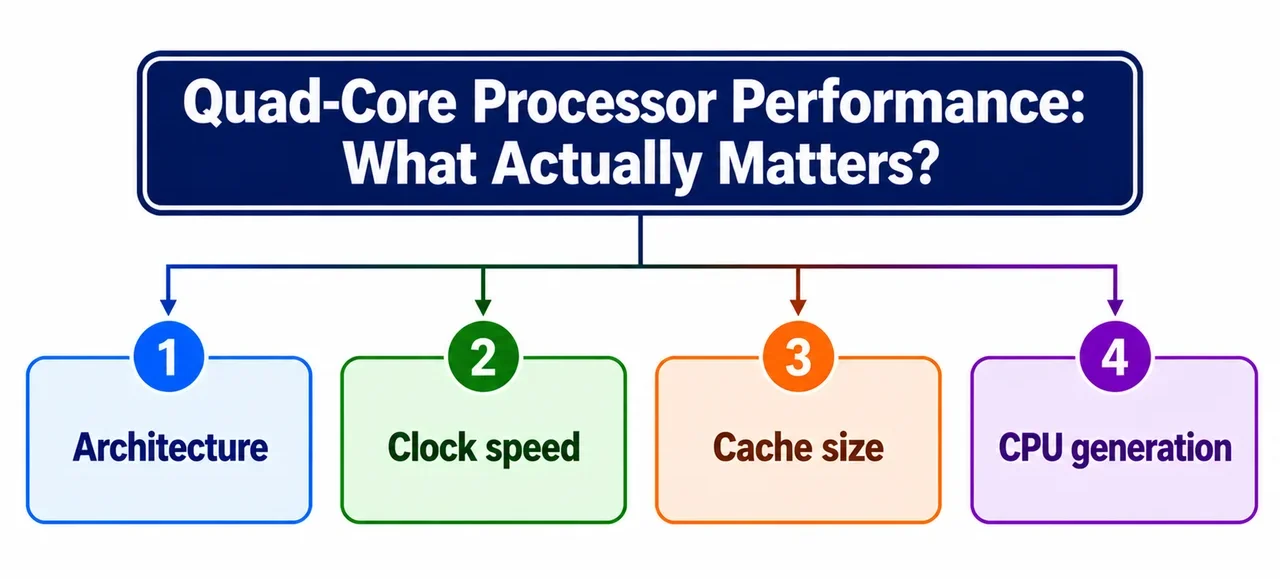
Clock speed also matters, especially for everyday tasks and applications that rely more on single-core performance. Cache size, CPU generation, core design, and software optimization can further affect real-world speed.
This means an older 4-core CPU is not automatically faster than a newer 2-core CPU, and a modern quad-core can easily outperform an older processor with more cores. So, when comparing quad-core CPUs, focus on the generation and overall performance, not just the number of cores.
Conclusion
In this article we cover what is a quad-core processor. It can be a good choice for everyday computing, study, office work, and light gaming. However, not all quad-core CPUs perform the same. The processor’s generation, architecture, clock speed, threads, and other features also matter.
Frequently Asked Questions (FAQs)
Yes, a quad-core processor can be good for everyday tasks, multitasking, office work, browsing, and light gaming. A modern quad-core CPU can also be quite fast, but performance depends on its generation, architecture, clock speed, and other features.
Quad-core means that a CPU has four separate processing cores. These cores can work on different instructions and tasks, helping the computer handle multiple workloads more efficiently.
Generally, yes, especially for multitasking and software that can use multiple cores. However, a newer dual-core CPU can sometimes be faster than an older quad-core CPU because CPU generation and architecture also affect performance.
It can be enough for light and some modern gaming, especially when paired with a suitable gpu. However, demanding games may perform better with a newer processor that has more cores and threads.
Yes. A quad-core processor is usually more than enough for common student tasks such as browsing, online classes, Microsoft Office, research, programming, and watching videos.
Yes, a quad-core processor can run Windows 11, but having four cores alone does not guarantee compatibility. The CPU must meet Microsoft’s supported processor requirements, and the computer must also meet requirements such as TPM 2.0, Secure Boot, RAM, and storage.
No. Four cores do not always mean four threads. A CPU can have 4 cores and 4 threads, while some quad-core CPUs support 8 threads through technologies such as simultaneous multithreading (SMT) or Hyper-Threading.
Yes. 4-core processor and quad-core processor generally mean the same thing: a CPU with four processing cores. The terms are simply different ways of describing the same core count.



- Be Respectful
- Stay Relevant
- Stay Positive
- True Feedback
- Encourage Discussion
- Avoid Spamming
- No Fake News
- Don't Copy-Paste
- No Personal Attacks
- Be Respectful
- Stay Relevant
- Stay Positive
- True Feedback
- Encourage Discussion
- Avoid Spamming
- No Fake News
- Don't Copy-Paste
- No Personal Attacks
