What is Control Unit in CPU | Functions | Types – Working | Pros – Cons & Comparison
Published: 15 Sep 2026
When we use a computer, many tasks happen in just a few seconds. We open apps, type on the keyboard, save files, and browse the internet without thinking about what is happening inside the computer.
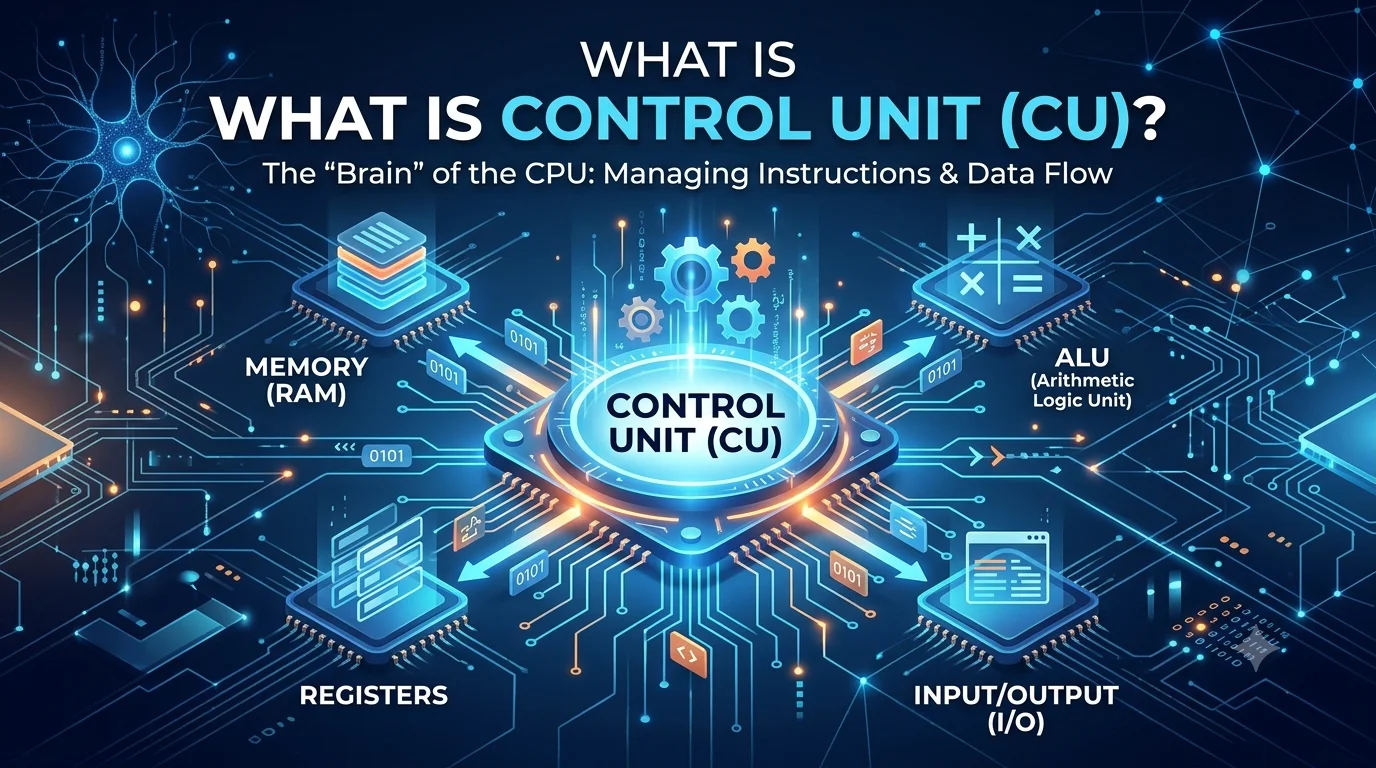
Behind all of these actions, one important component works continuously called the Control Unit (CU).
Definition of Control Unit
“The Control Unit (CU) is a major part of the Central Processing Unit (CPU) that manages and coordinates the activities of all other parts of the computer. It fetches instructions from memory, interprets them, and directs hardware components to perform specific actions.”
Why is the Control Unit Important?
A computer contains many parts such as memory, keyboard, processor, storage devices, and output devices. If all these components worked without coordination, the computer would fail to perform tasks properly.
The Control Unit ensures that every component works in the correct sequence. It acts as a traffic controller that keeps everything organized.
Without the Control Unit:
- Programs would not run properly
- Hardware components would not communicate correctly
- Instructions would not be executed in the right order
- The computer could not function efficiently
How Does the Control Unit Work?
The Control Unit works by following a process called the Fetch-Decode-Execute Cycle.
- Fetch: The first step is fetching instructions from the computer’s memory (RAM). Every program stores instructions, and the Control Unit retrieves them one by one. For example, when you click on a browser, the computer fetches the instruction needed to open that application.
- Decode: After fetching the instruction, the Control Unit decodes it. Decoding means understanding what action the instruction wants the computer to perform. For instance, the instruction may tell the computer to open a file, calculate a number, or display text on the screen.
- Execute: Once the instruction is understood, the Control Unit sends signals to the required components so the task can be completed. The instruction is then executed by other parts of the processor, mainly the Arithmetic Logic Unit (ALU).This cycle repeats millions of times every second.
Main Functions of Control Unit
- The Control Unit performs several important tasks inside a computer.
- It collects program instructions stored in memory so the CPU knows what task needs to be done next.
- It translates instructions into signals that the computer hardware can understand.
- It controls the movement of data between cpu, memory, input devices, and output devices.
- It sends commands to different hardware components and tells them when to start or stop working.
- It ensures all computer parts work together in the correct sequence.
Components Connected with the Control Unit
The Control Unit works closely with several computer components.
- Arithmetic Logic Unit (ALU): The ALU performs calculations such as addition, subtraction, multiplication, division, and logical comparisons. The Control Unit tells the ALU when calculations need to happen.
- Memory Unit: The memory stores instructions and data. The Control Unit fetches instructions from memory whenever needed.
- Input Devices: Devices such as keyboard and mouse send information to the computer. The Control Unit manages how the processor receives this information.
- Output Devices: Monitors, printers, and speakers display results. The Control Unit controls how processed data reaches these devices.
Example in Daily Use
Imagine you open a game on your computer. The Control Unit first fetches the game instructions from memory. Then it decodes those instructions and understands that graphics, sound, and controls need to load. After that, it sends commands to the processor, graphics card, memory, and display so the game starts running. All this happens almost instantly.
Types of Control Unit
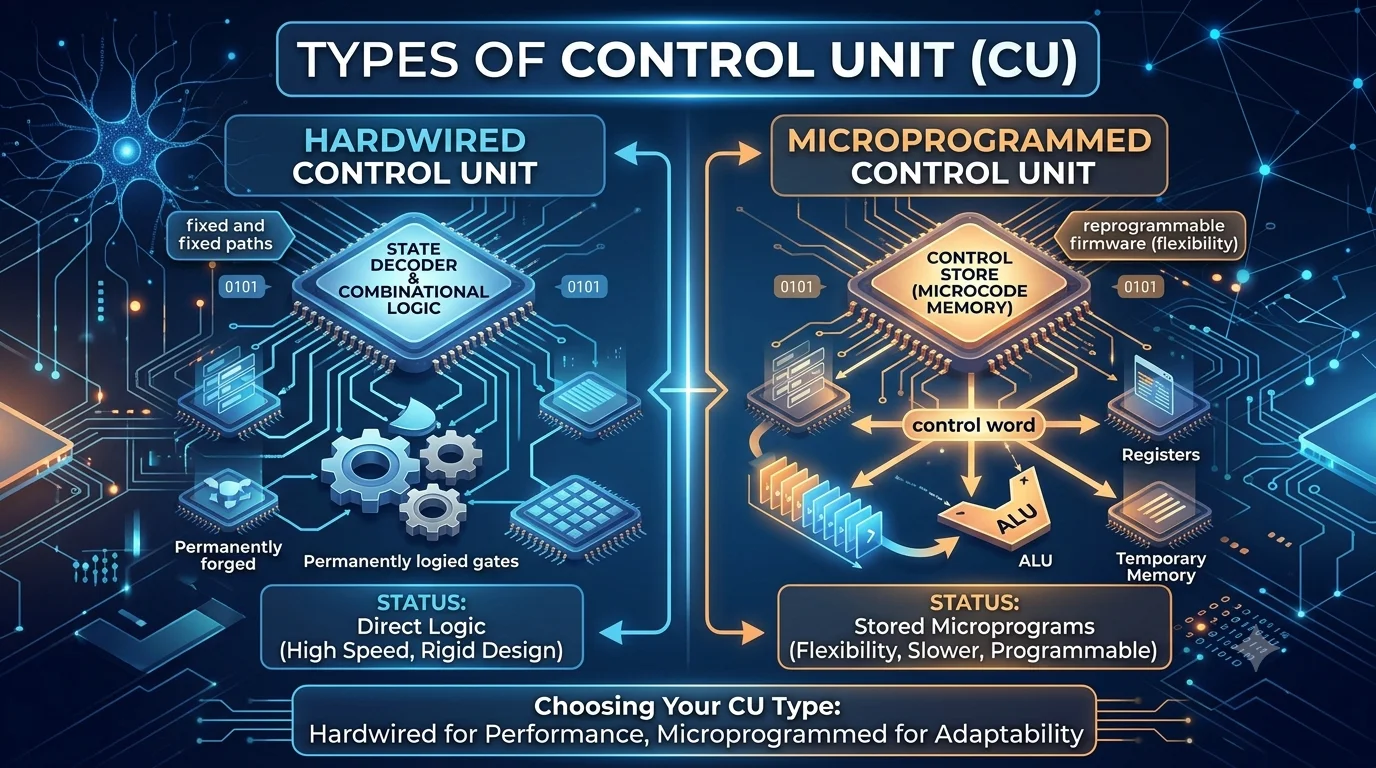
There are generally two types of Control Units used in computer architecture. let’s take a look on them.
Hardwired Control Unit
A Hardwired Control Unit is a type of control unit that controls the operations of the CPU using fixed physical circuits such as logic gates, decoders, and flip-flops. It directly generates control signals to execute instructions inside the processor.
Because it works through dedicated hardware connections, it performs tasks very fast. However, its design is fixed, so making changes or adding new instructions is difficult. It is commonly used in systems where speed is the top priority.
Microprogrammed Control Unit
A Microprogrammed Control Unit is a control unit that uses a set of stored instructions called microprograms to control CPU operations. Instead of relying on fixed hardware circuits, it reads instructions from memory and generates the required control signals.
This design makes it more flexible because changes can be made by updating the microprogram rather than redesigning hardware. Although it is slower than a hardwired control unit, it is easier to design and maintain.
Difference Between Control Unit and ALU
Many beginners confuse the Control Unit with the alu, but both have different jobs. Both are essential parts of the CPU.
| Control Unit (CU) | Arithmetic Logic Unit (ALU) |
|---|---|
| Controls all operations | Performs calculations |
| Directs data flow | Processes data |
| Decodes instructions | Executes mathematical operations |
| Acts as a manager | Acts as a worker |
Real-Life Example:
Think of a school! The principal gives instructions and manages teachers, students, and activities. The principal does not teach every class personally but makes sure everything runs properly.
The Control Unit works the same way inside a computer. It controls and manages operations but does not perform calculations itself.
Advantages of Control Unit
- Maintains proper coordination between computer components
- Executes instructions in the correct order
- Makes multitasking possible
- Improves overall system efficiency
- Allows smooth communication between hardware components
Limitations of Control Unit
Although important, the Control Unit has some limitations.
- It cannot process data directly
- Performance depends on processor design
- If damaged, the CPU cannot function properly
Conclusion
The Control Unit (CU) is one of the most important parts of a computer’s CPU. It works as the controller that manages all operations and ensures every component performs its task correctly.
In simple terms, if the CPU is considered the brain of a computer, the Control Unit is the part that organizes and controls how that brain works. Without it, a computer would not be able to follow instructions or perform tasks properly.


- Be Respectful
- Stay Relevant
- Stay Positive
- True Feedback
- Encourage Discussion
- Avoid Spamming
- No Fake News
- Don't Copy-Paste
- No Personal Attacks
- Be Respectful
- Stay Relevant
- Stay Positive
- True Feedback
- Encourage Discussion
- Avoid Spamming
- No Fake News
- Don't Copy-Paste
- No Personal Attacks
