Advantages and Disadvantages of Embedded System
Published: 15 Feb 2026
Embedded systems quietly work behind the scenes to make our everyday devices smart, fast, and reliable even though we don’t notice them most of the time.
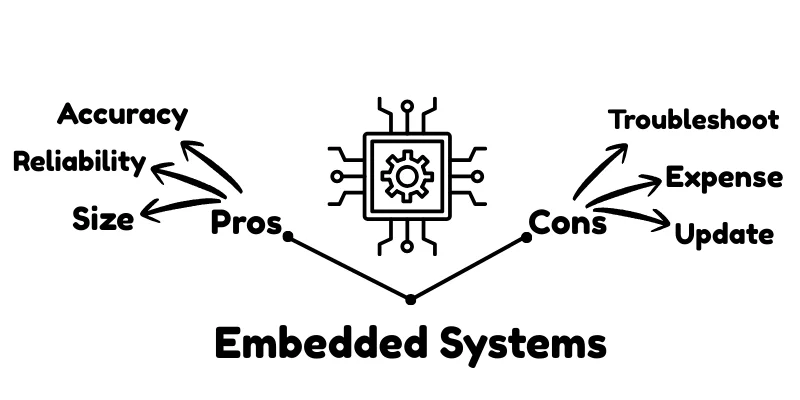
In our daily life, they control home appliances like washing machines, microwave ovens, air conditioners, and refrigerators, making them automatic and energy efficient. When you press a button and the machine responds perfectly, that’s an embedded system doing its job.
They are also inside smartphones, smart TVs, digital watches, elevators, and even traffic lights. These systems process commands instantly and keep everything running smoothly without human effort.
In this article, we will explore main Advantages and Disadvantages of Embedded System to help you clearly understand their powerful role in today’s technology.
Advantages of Embedded Systems
In this section, we will explore the benefits of using embedded systems, showing why they are essential in modern technology.
➤ High Reliability
Embedded systems are designed to perform specific tasks repeatedly without failure. This makes them highly reliable, which is why they are used in critical devices like medical machines or aircraft controls.
➤ Accuracy
Since embedded systems are built for dedicated functions, they can process data and execute commands very precisely. This ensures tasks are done accurately every time, reducing errors and improving overall performance.
➤ Compact Size & Portability
Embedded systems are usually small and designed to fit perfectly into the devices they control.
This compact size allows them to be integrated into gadgets like smartwatches, cameras, and home appliances without taking much space.
Because of their small size and low power requirements, embedded systems make devices easy to carry and use anywhere. This portability is why you can have powerful tech like handheld gaming consoles or portable medical devices.
➤ Energy Efficient & Battery-Friendly
Embedded systems are designed to use only the power they need for their specific tasks. This efficiency helps devices run longer without wasting energy.
Because they consume less power, embedded systems are perfect for battery-operated devices like remote controls, smartwatches, and portable medical equipment. This keeps devices running longer and reduces the need for frequent charging.
➤ Affordable for Large Scale
Once an embedded system is designed, it can be manufactured in large quantities at a low cost. This makes it ideal for products like smartphones, home appliances, and wearable devices.
➤ Reduces Overall Expenses
Because embedded systems perform dedicated tasks efficiently, manufacturers save money on extra components and energy usage. This cost-effectiveness benefits both producers and consumers.
➤ Immediate Response
Embedded systems can process data and perform tasks instantly, which is why they are used in applications where timing is critical, like traffic signals or medical monitoring devices.
➤ Consistent Performance
Since they are built for specific functions, embedded systems maintain consistent speed and accuracy. This real-time performance ensures that devices work smoothly without delays or errors.
Disadvantages of Embedded Systems
While embedded systems bring many benefits, they also come with certain limitations. In this section, we will discuss the main drawbacks.
➤ Fixed Functionality
Embedded systems are designed to perform specific tasks, which means they can’t easily adapt to new functions. Changing their purpose often requires redesigning the entire system.
Upgrading embedded systems can be challenging because the hardware and software are tightly integrated. This makes adding new features or improving performance harder compared to general-purpose computers.
➤ Expensive to Design
Creating an embedded system from scratch requires specialized hardware, software, and skilled engineers. This makes the initial design and development quite costly.
Even before mass production, a lot of money is spent on prototypes, testing, and fine-tuning. Although costs decrease with large-scale production, the upfront investment is still high.
➤ Time-Consuming Development:
Because every component and function is specialized, developing an embedded system can take more time and effort compared to general-purpose devices. This complexity increases the initial development cost and effort.
Designing an embedded system requires careful planning of both hardware and software. Engineers must ensure the system performs its specific tasks efficiently without errors.
➤ Hard to Identify Problems
Since embedded systems are specialized and compact, finding the exact cause of a malfunction can be tricky. Even a small fault in hardware or software can affect the whole system.
Fixing issues often needs skilled engineers who understand both the hardware and software of the system. This makes troubleshooting more complicated than with regular computers.
Final Words
Embedded systems play a powerful role in our daily lives, even though we rarely notice them. In this article, we explored benefits of embedded systems and drawbacks of embedded systems clearly.
My personal advice is to not just use technology, but try to understand how it works behind the scenes. If you have any confusion, feel free to ask in comments section. Thanks for you love and support.

- Be Respectful
- Stay Relevant
- Stay Positive
- True Feedback
- Encourage Discussion
- Avoid Spamming
- No Fake News
- Don't Copy-Paste
- No Personal Attacks
- Be Respectful
- Stay Relevant
- Stay Positive
- True Feedback
- Encourage Discussion
- Avoid Spamming
- No Fake News
- Don't Copy-Paste
- No Personal Attacks
