What are Types of CPU | Single to Deca Core Covered
Published: 15 Sep 2026
Have you ever thought why some computers are slow while others can run games, videos, and many apps at the same time without hanging? That’s all, the game of CPU Speed. CPU stands for central processing unit.
Just like our brain tells our body what to do, the CPU tells the computer how to work. The CPU quickly processes instructions and makes everything run smoothly. I promise it’s easy! Let’s explore the different types of CPUs in this article:
CPU Types by Core Count
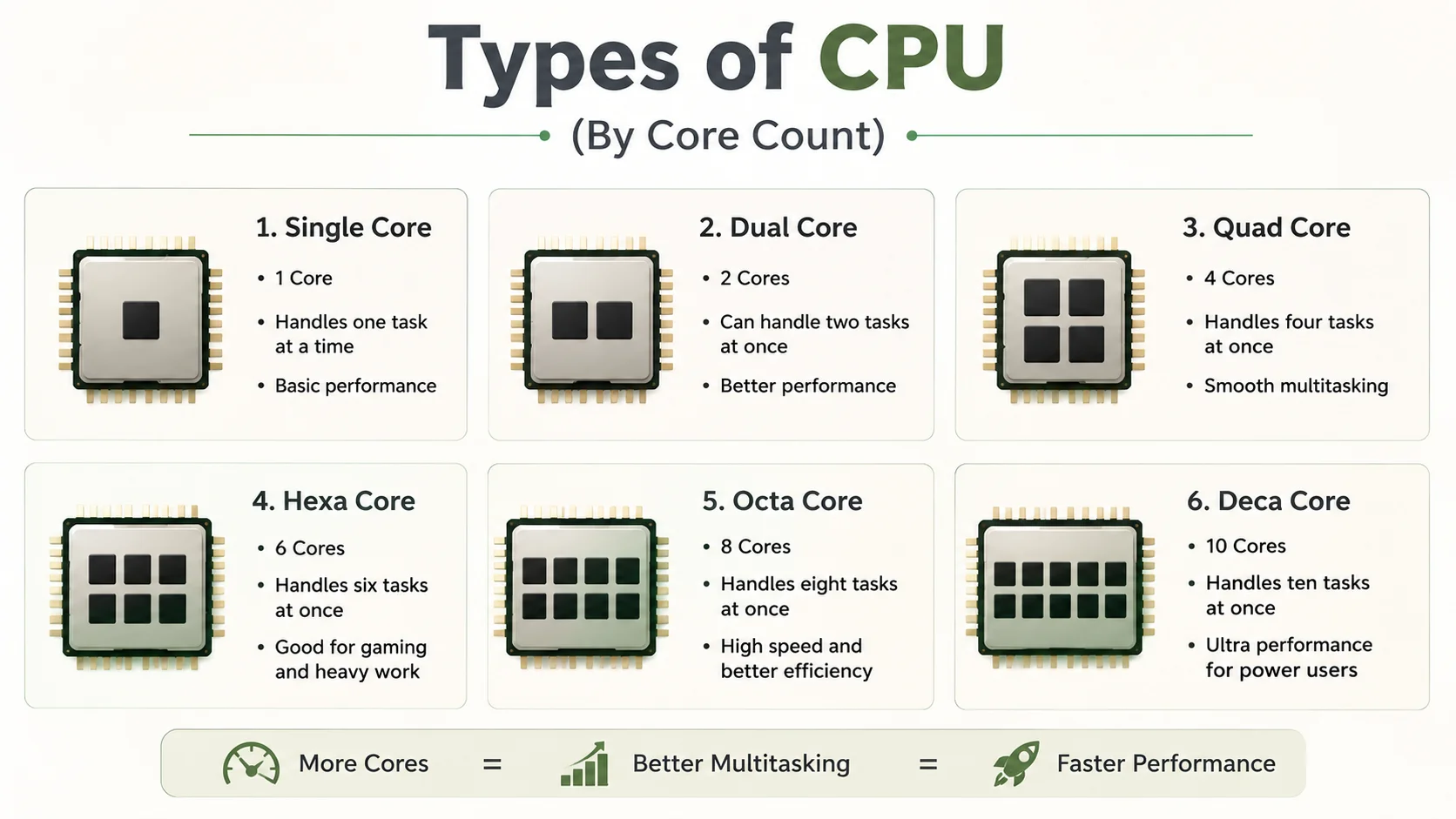
CPU cores play an important role in how a processor handles tasks. A CPU can have one core or multiple cores, such as dual-core, quad-core, hexa-core, and octa-core.
In this section, we’ll explore the different types of CPUs based on their core count and understand how each type works.
1. Single-Core Processor
A single-core processor is a CPU that has only one core, which means it can handle only one task at a time. It was commonly used in older computers before modern multitasking became popular. These processors are suitable for basic activities like typing, simple calculations, and small programs.
2. Dual-Core Processor
A dual-core processor has two cores inside one CPU, allowing it to perform two tasks at the same time. It provides better speed and multitasking compared to a single-core processor.
Dual-core CPUs are suitable for everyday tasks like studying, browsing, and watching videos. In 2000, IBM introduced the world’s first commercial dual-core microprocessor called the POWER4 processor.
In 2004, HP and Sun Microsystems & in 2005, AMD launched their own dual-core server processors. Later in 2006, Intel launched the Core 2 Duo processor for personal computers, making multitasking faster for everyday users.
3. Quad Core Processor
A quad-core processor is a CPU that contains four cores inside a single processor. It can handle multiple tasks at the same time, making the computer faster and more efficient than Single and Dual-core CPUs.
Quad-core CPUs are commonly used for gaming, multitasking, and running heavy applications smoothly. The first quad-core processor was introduced in 2006 commercially by Intel with its Core 2 Quad processor series.
It combined four processing cores in one CPU to improve multitasking and performance. Around the same time, in 2008, AMD joined the race and released its Phenom X4, and in 2009, the Athlon II X4 series of processors.
4. Hexa-Core Processor
A hexa-core included six cores in one CPU, providing powerful performance for gaming, video editing, and professional work. It can handle many tasks at the same time, giving faster performance than Single, Dual and Quad-core CPUs.
AMD introduced the first hexa-core processor in 2010 with the Phenom II X6 series. It helped AMD compete strongly in the high-performance CPU market. In 2010, Intel also introduced its Core i7-980X processor.
5. Octa-Core Processor
An octa-core processor is a CPU that has eight cores inside a single chip. It can perform many tasks at the same time, with more speed and efficiency than Single, Dual, Quad and Hexa core CPUs.
AMD introduced the first octa-core desktop processor in 2011 with the FX-8150 (Bulldozer architecture). It provided eight cores to improve multitasking and gaming performance.
In 2014, Intel introduced its first eight-core desktop processor called the Intel Core i7-5960X Extreme Edition, based on the Haswell-E architecture
6. Deca-Core Processor
A deca-core processor is a CPU that contains ten cores inside a single processor chip.
It can handle many heavy tasks at the same time, providing fast performance and smooth multitasking more than single, dual, quad, hexa, and octa-core CPUs.
The first deca-core processor was introduced in 2015 by MediaTek with its Helio X20 (MT6797) processor. This innovation helped mobile devices handle heavy apps and multitasking more efficiently.
CPU Types by Purpose
1. General-Purpose CPU
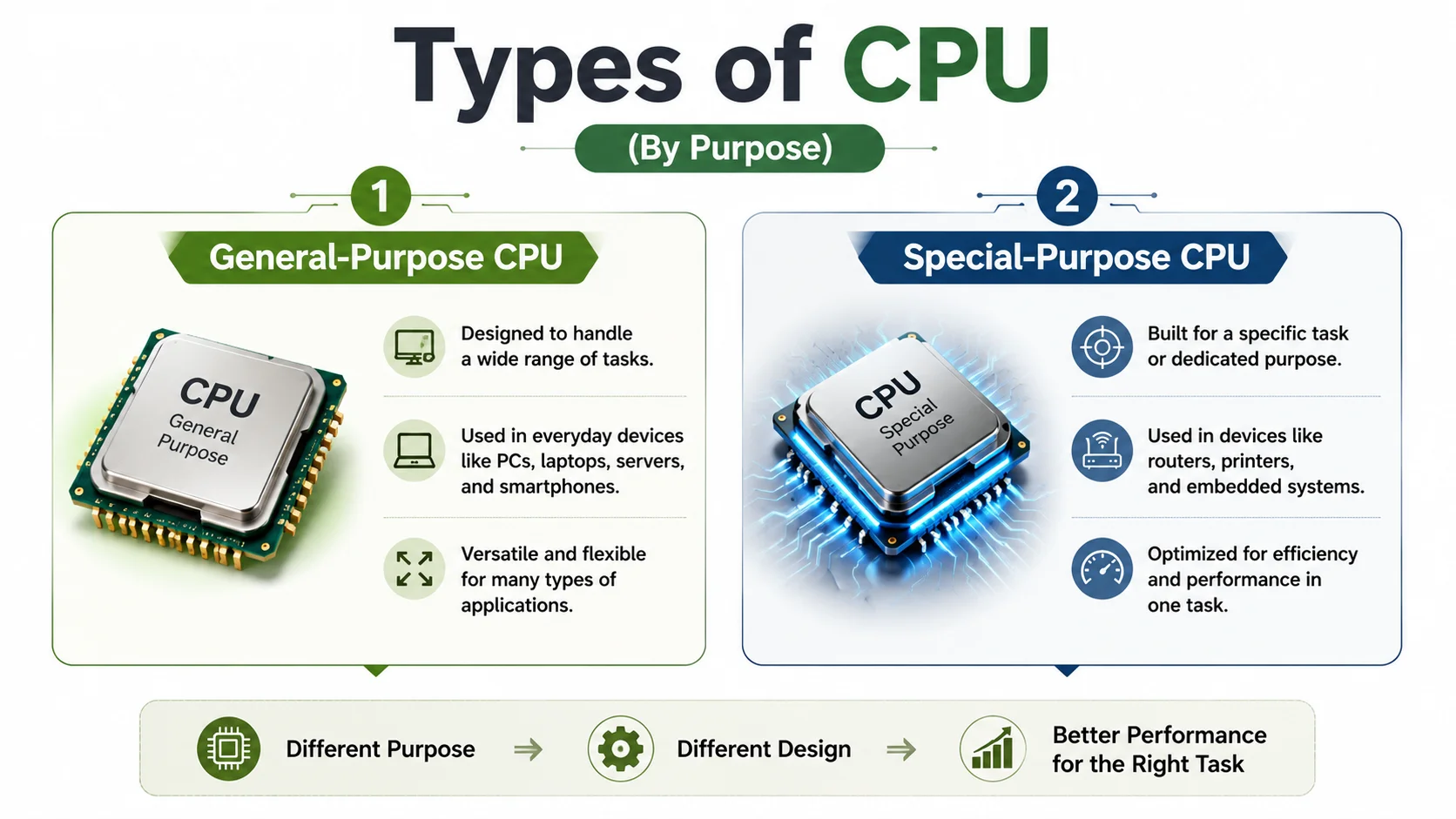
A General-Purpose CPU is designed to handle many different types of tasks instead of doing only one specific job. It can run operating systems, web browsers, office programs, games, and other software. These CPUs are commonly found in desktop computers, laptops, and servers. Their main advantage is flexibility, as you can use the same CPU for different tasks without needing a separate processor for each one.
2. Special-Purpose CPU
A Special-Purpose CPU is built to perform a specific type of task or work within a particular system. Unlike general-purpose CPUs, it is optimized for a limited function, which can make it efficient for that job. These processors are commonly used in embedded systems, appliances, vehicles, and industrial machines where the same task needs to be performed reliably.
CPU Types by Instruction Set
1. CISC (Complex Instruction Set Computer)
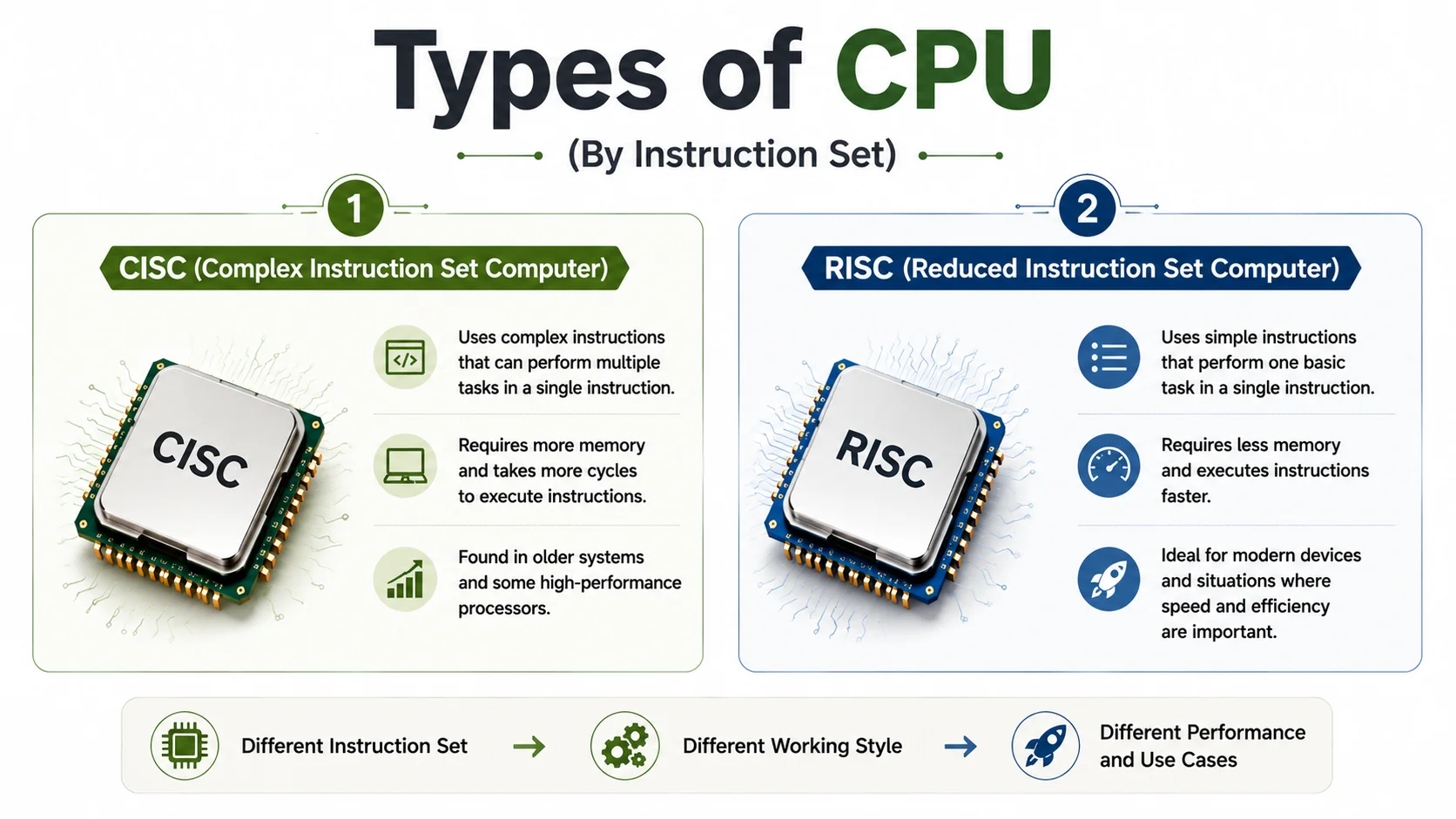
CISC processors use a large set of instructions, including complex instructions that can perform several operations with a single instruction. This can reduce the number of instructions needed to complete certain tasks. x86 processors from Intel and AMD are common examples of CISC-based processors and are widely used in desktops and laptops.
2. RISC (Reduced Instruction Set Computer)
RISC processors use a smaller and simpler set of instructions, with each instruction designed to perform a basic operation efficiently. This simpler design can make processors easier to optimize for speed and power efficiency. ARM-based processors are a common example and are widely used in smartphones, tablets, and many embedded devices.
Final Words
In this article, we learned about the different types of CPU processors, including Single-Core, Dual-Core, Quad-Core, Hexa-Core, Octa-Core, and Deca-Core processors. We also discovered who invented them and when they were introduced in the world of computers and smartphones.
We hope this article helped you understand CPU types in a simple and easy way. If you still have any confusion or questions, feel free to ask – learning technology becomes more interesting when we learn together.



- Be Respectful
- Stay Relevant
- Stay Positive
- True Feedback
- Encourage Discussion
- Avoid Spamming
- No Fake News
- Don't Copy-Paste
- No Personal Attacks
- Be Respectful
- Stay Relevant
- Stay Positive
- True Feedback
- Encourage Discussion
- Avoid Spamming
- No Fake News
- Don't Copy-Paste
- No Personal Attacks
